The JT705C Intelligent Video Customs Lock is an advanced security solution for valuable cargo, offering real-time tracking and remote video monitoring. Ideal for customs supervision, supply chain risk control, and valuables transportation, it features online/on-spot unlocking, impact/rollover monitoring, tamper alarms, and event-triggered video recording. With robust design and comprehensive functionality, the JT705C ensures cargo safety and transparency throughout the transportation process.
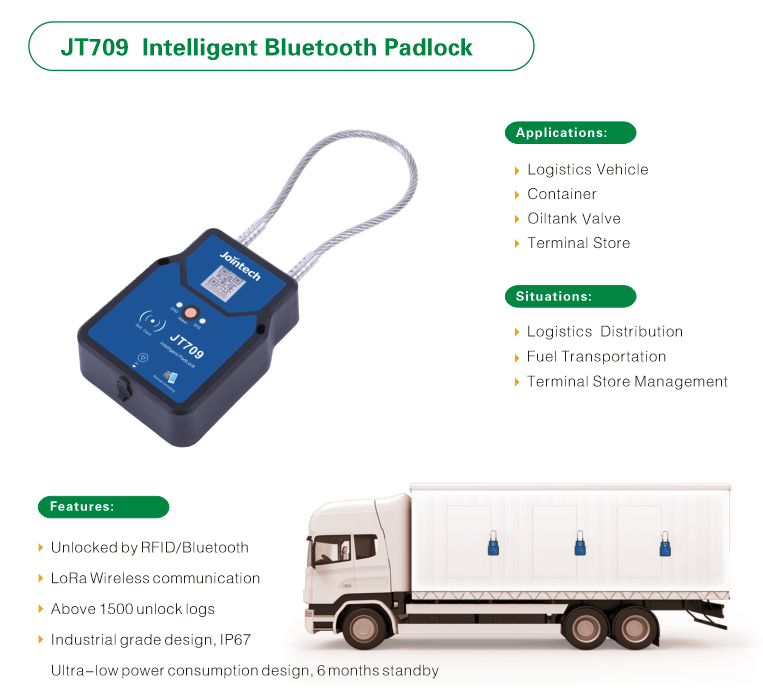
JT709 is a type of Bluetooth-enabled padlock and working with master lock JT701, for the application of muti doors monitoring. It is special designed for solution of master-slave lock, and widely used for remote asset management, such as: single door container, muti doors container, logistic van, etc.
The JT705A Intelligent Container Monitor is a cutting-edge solution for real-time cargo tracking and security during transportation. Suitable for containers, refrigerated containers, and vans/trucks, it features remote/on-site unsealing, a large battery, real-time voice operation, and an OLED display for device status. With anti-theft, anti-impact, anti-rollover, and anti-dismantling capabilities, it ensures comprehensive protection for railway, city road, customs, refrigerated cargo, and financial risk monitoring. The JT705A delivers reliable, efficient, and secure cargo management.
The JT709C Smart Electronic Tracking Lock by Jointech is a compact, intelligent seal lock designed for logistics and asset management. It offers real-time positioning, remote unlocking via BLE, and phone APP unlocking for convenience. With over 2000 unlock records storage, an IP67 industrial-grade design, and rechargeable functionality, it ensures durability and sustainability. Ideal for containers, vans, bank cash bags, and warehouse doors, it is widely used in logistics distribution, asset tracking, and terminal monitoring. The JT709C provides a reliable, eco-friendly solution for secure and efficient operations.
JT706, Intelligent Container Tracker, is a product with the combination of management,tracking and environment monitoring for containers. Its secret installation fits well in ventilation for containers. It supports GPS and LBS. Its smart detecting of empty loading or full loading. The real-time monitoring of temperature and humidity inside the containers and door status of containers can be achieved, which secures cargo safety. It is an intelligent solution featuring with safety and humanity.
Container Tracker JT704, a monitoring device for containers, custom containers and special containers, possess the function of real-time tracking, fixed-time tracking,intelligent power management, long standby, perforation-free installation and high invisibility. It is mainly applied in railway transportation, marine cross-border transportation,special container asset monitoring and Belt & Road railway cross-border transportation.
The JT301A Asset Tracker is an efficient asset management device widely used in containers, box trucks, train cargo, and pallets. Its main features include timed LBS location tracking, door opening and closing monitoring, and illumination monitoring. This device is compact, lightweight, easy to install, and has ultra-low power consumption. It is rechargeable and reusable. The JT301A Asset Tracker is suitable for logistics and distribution, asset tracking, global supply chain management, and express packages, providing users with an efficient and reliable asset management solution.